

everything is stupid: the dumbification of media
why do people on screen talk like that?

Recently I watched a clip from an interview with actress Jameela Jamil, where she explains how TV shows are purposefully “dumbed down” so viewers will be able to follow along while scrolling on their phones. That video then led me to reconsider my criticism of a lot of modern media: that it’s kind of stupid.
The first time I distinctly felt like my intelligence was belittled was when watching the movie of the summer of 2023: Barbie. My problems with the movie operate on several levels, one of which being that it is pretends to criticize the industry that funds it. Its supposedly self-aware criticism of capitalism is in service of the very values of that system, rebranding Mattel as “self-aware” and ensuring its commercial success. Its surface-level critique of consumerism while it embodies its very essence as a commercial product ultimately resolves into somewhat of “woke capitalism”–same values preserved, under pretty pink packaging.
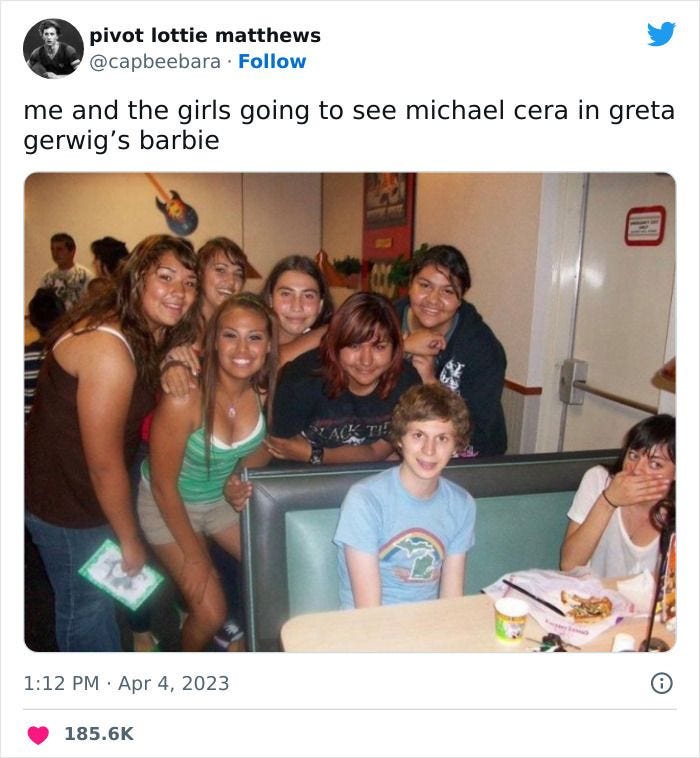
Before I get too carried away, this isn’t the only, or even the main thing, that made me feel like my media literacy was being ridiculed. It was what I like to call its “feminism for dummies” messaging. The core messages of the prevalent effect of patriarchy and the unrealistic expectations set on women are not insignificant or unimportant, but did they have to deliver them like that?
The film feels like a course of feminism 101, riddled with realizations about society that most women have reached as teens. It is a film clearly made for a western, white female audience–so far detached from the realities of many women in a way that makes it almost ridiculous. And the real audience–women all around the world that grew up with the Barbie brand–don’t need Margot Robbie, the embodiment of oppressive western beauty standards, to teach them how hard it is to be a woman. Trust me, we know.
After that, I realized I was being talked to like a dumb, slow to understand child of five years by most pieces of mass media. Netflix shows that virtually narrate to me what is happening on screen, shallow messaging reiterated as if it wasn’t so very clear the first time around, and plot so simple a child could have come up with it. I think I read (and wrote) fanfiction more intricate when I was a pre-teen than many series available to binge-watch on streaming. Not because I was a literary prodigy or engaging in some neurotic classical book club at 12, but because it is all so very shallow, simplified, and basic now.
However, the media product that propelled me to write this was no other than Wicked 2: For Good. As an avid musical fan (a gay girl, after all) I was already hesitant when I realized they planned to turn Act 2 of Wicked into its own 2-and-a-half hours long movie; it simply does not hold enough substance to carry it.
Watching the movie this weekend, I was surprised to find myself hearing the same lines, repeated over and over by different characters. While it is a safe and easy way to create a sense of closure and catharsis in the narrative, it is also a sure way to exhaust your audience and make them feel… well, stupid.
The entire movie serves as a conclusion to its previous act, and as such, it is bound to be a bit repetitive. It is also limited by the fact that the musical itself invites this sense of repetition, in the form of reprises. That in itself is not a fault. Being unable to say anything interesting, however, might be.
Marshall McLuhan1, the media theorist, coined a term repeated as much as the lines in Wicked: “The medium is the message.” The form of the medium dictates its message because it dictates the very way you can communicate through it and the type of messages you can, or cannot, convey through it. A film could never carry the same message as a book. Its form is fragmented, emotion-orientated, and its output is one that invites and encourages passivity rather than active engagement. As such, it cannot be expected to engage its audience in complex ideas at all times. And a mass media product, with its desire to appeal, well, to the masses, it has to be a formulaic, easily digestible piece of media.
This is not a new idea–media theorists Theodor W. Adorno and Max Horkheimer have explained this back in the 1940s. Mass production of cultural goods, such as films, lead to the reduction of the product itself. It is standardized, it is simplified, and they even go on to say that the purpose of these “cultural” products is to pacify and disarm the public. And of course, to get the masses to believe they need these products and to get them to buy into them.2 That’s just business, and that’s why everyone on screen talks like that nowadays–they simply have to, in order to do great at the box office or on the streaming services.
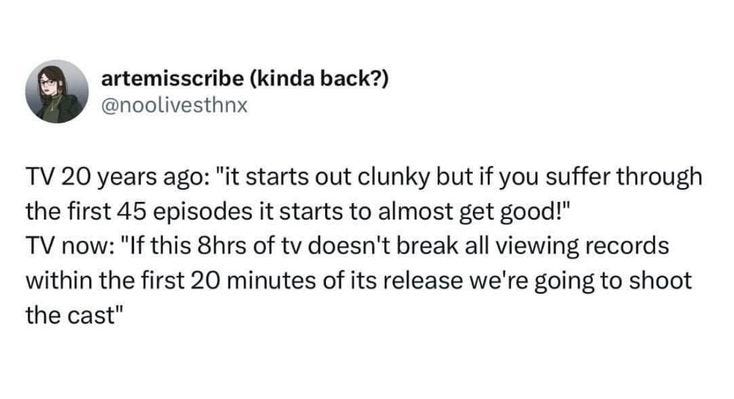
But why should that be taken at face value and quietly agreed to? If the TV, the screen, is the defining medium of our time, shouldn’t we expect better from it?
Don’t we deserve entertainment that is stimulating, not just emotionally but also intellectually? Media is often something that provides comfort, of course, but shouldn’t it also provide its audience with a new framework through which to understand it? Shouldn’t it ask us not just to consume, but also to engage, to make meaning, to discover its significance and to grant it too?
There is good, profound, deeply engaging and moving media out there. I know that because I do my best to find it. But why is the default shallowness, and frankly, boring repetitiveness?
Maybe my expectations are too high. I would be content simply with media that doesn’t assume its audience’s idiocy.
Thank you so much for reading! If you enjoyed this post, consider subscribing to back to shore. I don’t currently offer paid subscriptions, but if you want to support me and my work, you can contribute however much you choose to, right here. No pressure, just my gratitude for you being here. Until the next one :)
This is the sister, or close cousin, of a previous post of mine, in which I use media theories to discuss pop culture and politics. If you enjoyed this one, you might like that one too!
the popification of politics

In Amusing Ourselves to Death (1985), Neil Postman argues that the age of TV has turned everything into entertainment, and as a result it also turned politicians into celebrities. He was definitely right, but I want to suggest another thing: by blurring the lines between serious things – like politics – and entertainment, celebrities are now expected to…
every time i quote him (which is a lot) i think about his cameo, as himself in a woody allen film. life is weird, guys.
if you want to hear more about this, i recommend looking up “culture industry”: its the key term of their theory presented in “The Culture Industry: Enlightenment as Mass Deception”; everything i attributed to them here is what i learnt studying this theory.
I WAS NODDING WITH EVERY SINGLE LINE. noam i agree so much it is not even funny, thank you so much for writing this because now i'm equal parts fuming that this is happening and excited that someone is finally talking about it. i find this dumbing-down epidemic in media truly concerning and i don't even know what we can do to escape it
Omg yes. I was recently thinking about this again when I finally got around to watching Materialists and had to close it like 20 minutes in. The themes in art are being screamed into our ears and silencing the actual art in the art.